A Drone Net Is Not Just a Stronger Net
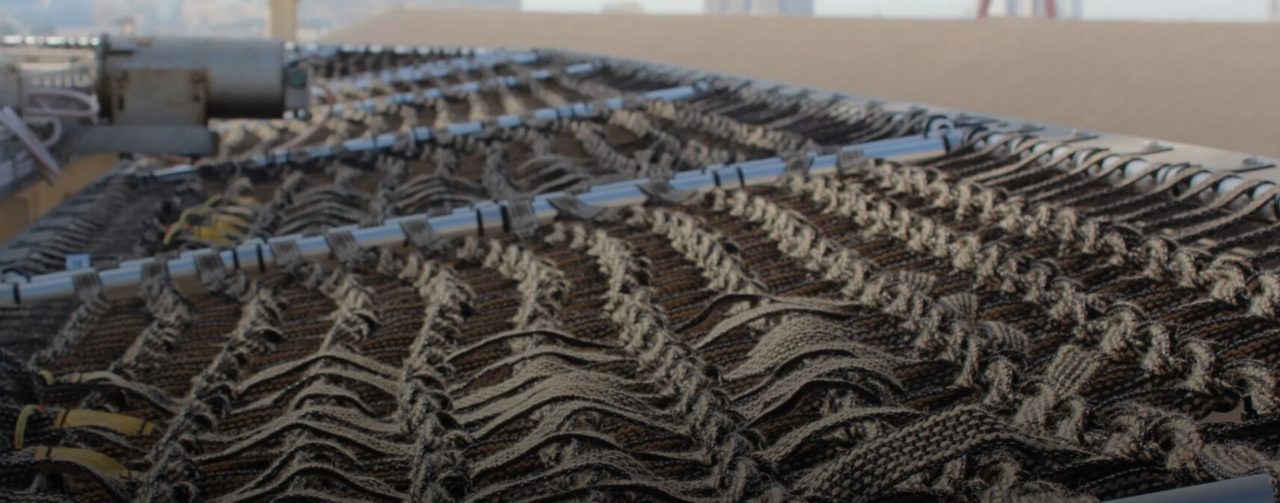
The net is the visible barrier. The important details are tension, edge connection, working distance and what the net is designed to meet.
The important question is not only what the net is made of. It is what the net is expected to stop, how it behaves on impact and what remains between the threat and the asset.
On most visuals, the net gets the attention.
That is fair. It is the layer the drone meets first. It is also the part that makes the idea easy to understand: something physical stands between the UAV and the asset.
But this is also where the subject is easy to oversimplify.
A drone net is not ordinary mesh made stronger. It is not the same thing as debris netting, bird netting or a heavy fence. Those products may be useful in their own jobs, but they are not usually specified for a powered UAV arriving at speed, from an uncertain angle, possibly carrying something that creates a much larger risk than the drone body itself.
That is why the first question should not be “how strong is the net?”
The better question is what the net is being asked to do.
The concern is often what the UAV carries
In many real cases, the drone is only part of the concern.
The more serious question is what it may be carrying.
That changes the way the net should be discussed. A responsible supplier should not describe the net as making a hazardous or explosive payload harmless. That is not the right promise.
The more realistic purpose is to intercept the UAV before direct contact with the asset, reduce what continues toward the asset and keep as much separation as possible between the threat and the protected equipment.
This is why distance matters.
If the net is installed too close to the transformer, tank, vehicle or container it is meant to protect, it may not have enough room to work. A successful interception still needs space behind it. On a drawing, that space can look like empty area. In practice, it may be part of the protection.
Strength alone does not describe performance
Strength matters, of course. But it does not tell the whole story.
A very stiff barrier can pass a sharp force into the supporting structure. A net that moves in a controlled way can change the event by slowing the UAV and reducing the remaining movement toward the asset.
That does not mean the net can be soft or weak. It means the useful performance is a combination of strength, elongation, energy absorption, tension and the way the panel is held at its edges.
This is also why generic comparisons can be misleading.
A net may have impressive material strength and still be poorly suited to a specific layout. Another net may perform well in a tested panel size, but need a different arrangement when the span, height or expected UAV changes.
The specification needs to say what case is being considered.
Size, shape, speed, weight and impact angle all matter. So does whether the concern is a small surveillance drone, a heavier UAV or a payload scenario. A label alone is rarely enough unless the assumptions behind it are understood.
The edge is part of the net
The edge detail is easy to treat as a secondary item.
It should not be.
A net becomes a barrier only when it is tensioned and connected. The edge decides how the load leaves the panel. If it spreads the load evenly, the rest of the structure can be designed around that. If it concentrates the load into a few points, those points may become the weak part of the protection.
This is not only an engineering detail. It affects what the buyer is really buying.
Buying “netting” by square metre is not the same as buying a protective panel with a defined edge condition, tensioning method, inspection approach and replacement route.
After an impact, somebody also has to know what is checked, what can be reused and what should be replaced. That should not be invented after the first incident.
Passive does not mean simple
One of the strengths of a physical drone net is that it is passive.
Once installed, it does not depend on detection software, radio link, jamming, power supply or an operator decision at the moment of attack. That is a major advantage, especially for assets where active countermeasures may not be available, allowed or sufficient.
But passive should not be confused with simple.
A passive net still has to be specified. The threat has to be defined. The working distance has to be understood. The panel behaviour has to be known. The edge and support conditions have to match the expected loads.
In demanding cases, multilayer netting may also be considered. That is not a generic upgrade to add casually. It should follow the protection level, the expected threat and the structure around the net.
What HelixHold specifies around the net
For HelixHold, the net is the visible protection layer.
That wording is deliberate. The net is not decoration around the system. It is the part intended to meet the UAV before the UAV reaches the asset.
What HelixHold adds around it is the practical specification: what asset is being protected, what UAV threat is being considered, how much working distance is available, how the net is held, and what kind of frame and anchoring are needed for that arrangement.
The high-performance drone netting, the steel support structure and the foundations are not separate guesses. They have to match the same protection case.
For the buyer, this reduces an important risk. It is possible to buy strong netting, strong steel and strong foundations and still have an unclear protection concept if nobody has defined how they are meant to work together.
A drone net is valuable because it is the layer that intercepts the threat.
It becomes physical C-UAS protection only when its performance, edges, distance and support structure are specified for the asset in front of it.
Planning protection for an exposed asset?
Send the information you already have. We will identify the next technical details required.
Request a site reviewRequest a technical call